What USDA Zones Tell You and What They Skip in Indiana
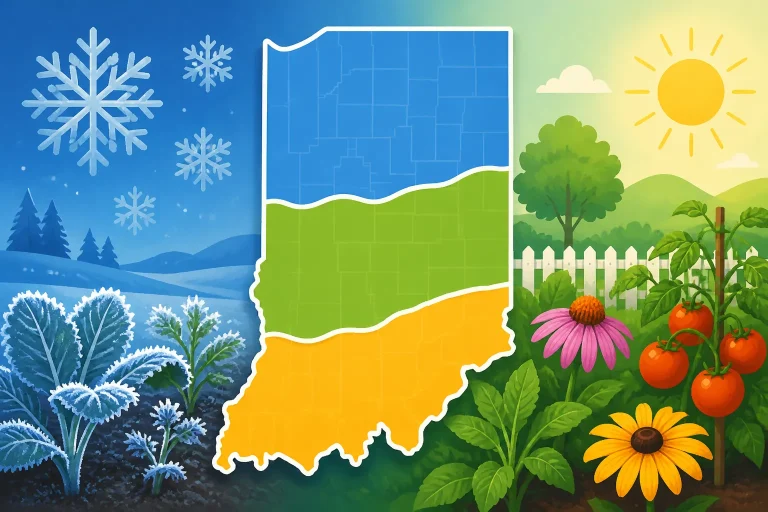
A USDA hardiness zone can help you choose trees, shrubs, and perennials that are more likely to survive an Indiana winter. It cannot tell you when to sow tomatoes, whether your soil is workable, or how soon frost will arrive in your yard. The useful approach is to treat the zone as one piece of a planting plan, then use local weather, soil, and crop needs to make the rest of the decisions.
What a USDA hardiness zone measures
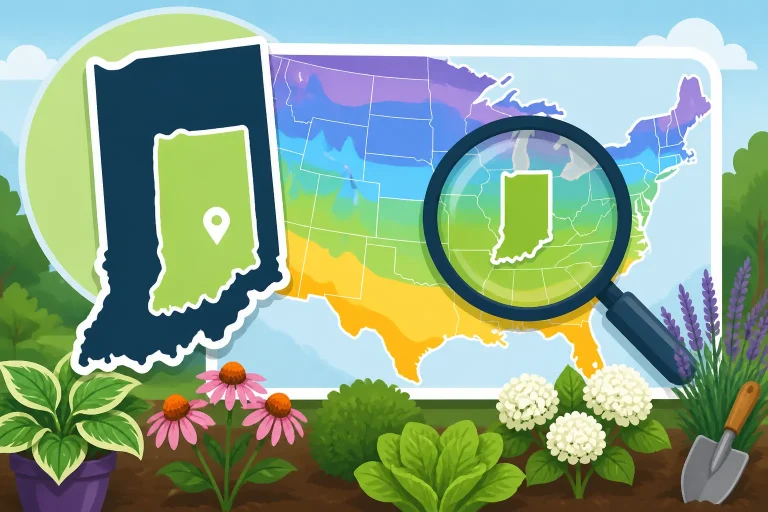
The USDA Plant Hardiness Zone Map groups locations by their average annual extreme minimum winter temperature. It is designed primarily to help gardeners assess whether a perennial plant can survive the coldest part of winter in a given area.
Zones are arranged in 10-degree Fahrenheit bands, with each zone divided into 5-degree half-zones marked “a” and “b.” The numbers describe a range, not a promise that a particular winter will stay within that range. An individual winter can be milder or colder than the average used to map the location.
That distinction matters. A plant label may say a plant is hardy in certain zones, but that rating is a guide to its ability to tolerate winter cold—not a guarantee that it will thrive in every yard within those zones. A plant’s actual performance also depends on how established it is, whether it is protected from wind, the condition of the soil, drainage, snow cover, and swings between freezing and thawing.
If you want to check the zone for a particular area, use the USDA map rather than relying on a generalized state map or a zone remembered from an older chart. The map is intended for geographic lookup, and a ZIP code is only a starting point: conditions can vary within a ZIP code. How to Look Up Your Planting Zone by ZIP Code on the USDA Map
A hardiness zone is most useful when you are choosing plants that remain outdoors year after year. It gives you a first screening question: is this plant rated to withstand the typical winter cold in this area? It does not answer the rest of the questions you need to ask before planting.
What a zone can help you choose
For Indiana gardeners, hardiness zones are most useful for narrowing choices among landscape plants and other long-lived plants. If a nursery label lists a hardiness range, compare that range with the zone shown for your location on the current map. A plant rated for colder winters than your area generally has a wider margin against winter cold, though that alone does not make it the best choice for the site.
Consider the plant’s whole growing environment. A shrub that can tolerate winter lows may still struggle in a spot with wet soil, intense afternoon sun, heavy shade, or exposure to drying winds. A perennial with an appropriate hardiness rating may fail if the bed stays waterlogged or if new growth is repeatedly damaged by spring temperature swings.
| Gardening question | What the hardiness zone can tell you | What else to check |
|---|---|---|
| Could a perennial survive typical winter cold here? | Whether the plant’s winter rating is a reasonable match | Drainage, exposure, snow cover, and establishment |
| Is this shrub likely to overwinter? | Whether its listed hardiness range overlaps your mapped zone | Sun, soil moisture, wind, and mature size |
| When should vegetables be planted? | Very little about the planting date | Frost risk, soil temperature, crop type, and local conditions |
| When will the last spring frost happen? | It does not give a frost date | Regional frost guidance and current forecasts |
| Will a plant tolerate a hot, dry summer? | Not reliably; the map focuses on winter cold | Heat tolerance, rainfall, irrigation, and soil |
| Can a plant grow in this exact yard? | A broad regional clue | The yard’s microclimate and growing conditions |
Hardiness ratings are especially useful when comparing plants that are otherwise similar. If one candidate is rated for colder conditions and another is marginal for the mapped area, the colder-rated option may provide more winter resilience. But “hardier” is not the same as “better.” Plants also need the right amount of sun, moisture, and space.
The map can also help set expectations. A plant at the edge of its listed hardiness range may survive most winters but be more vulnerable during a particularly severe cold spell or when other stresses are present. Think of the rating as a risk indicator, not a guarantee. Should You Choose Plants Rated One Zone Colder for Indiana Yards?
For trees and shrubs, consider more than survival. A plant may live through winter yet produce poor growth or suffer recurring damage. A marginally hardy plant might need a sheltered location, while a plant well suited to the zone may still be a poor match for compacted soil or standing water. For native plants, matching local soil and moisture conditions can be as important as checking winter tolerance. Choosing Indiana Native Plants: Beyond Hardiness Zones
What USDA zones do not tell you
A hardiness zone is a narrow measure. It does not describe the full climate of a garden, and it should not be used as a planting calendar.
It does not give a last frost date
The zone map does not tell you when spring frost is likely to end in your town, neighborhood, or yard. Even nearby gardens can experience different frost conditions. Cold air tends to settle in low spots, while slopes and sheltered locations may warm differently. Regional frost dates are probabilities drawn from weather records, not fixed dates for every year.
That means a hardiness zone cannot answer, “Can I put this seedling outside today?” For that decision, consider the crop’s cold tolerance, the forecast, and the risk of a frost at your location. Indiana Regional Frost Dates: North, Central, and South Guides explains how regional frost information can help you set expectations, while Spring Frost Risk in Indiana: How to Read Freeze Probabilities focuses on interpreting probability rather than treating a date as a guarantee.
A zone also does not tell you when fall frost will arrive. That matters for late plantings, fruiting crops, and vegetables that need time to mature. Use a local fall-freeze estimate as a planning aid, then adjust for the season’s actual weather and the crop’s days to maturity. How Reliable Are Regional First Fall Freeze Dates in Indiana?
It does not measure summer heat
The map is about winter minimum cold, not the summer conditions that can stress a plant. It does not indicate the duration of a heat wave, hot nights, humidity, or the effect of reflected heat near pavement and buildings.
That gap is important for both ornamentals and vegetables. A plant may be winter hardy but struggle in a hot, exposed site. Cool-season vegetables can bolt or lose quality as temperatures rise, even though their winter hardiness is not in question. Warm-season crops, meanwhile, need sufficiently warm soil and nights to grow well. The zone number does not supply those thresholds.
It does not describe rain, drought, or soil moisture
Two locations in the same zone can have very different moisture conditions. A hardiness zone does not show whether a bed drains quickly, remains saturated after rain, or dries out during a hot spell. It does not reveal the texture or compaction of your soil.
Those differences influence plant health throughout the year. Roots in poorly drained soil may be damaged in wet periods, while shallow-rooted plants in a dry bed may need more attention during drought. A winter rating cannot compensate for a site that does not meet a plant’s moisture needs.
It does not tell you whether your soil is ready
A map cannot tell you whether garden soil is too wet to work, whether it has warmed enough for a particular seed, or whether the bed is compacted. These are practical planting questions that depend on the actual soil, not the regional hardiness category.
Working very wet soil can damage its structure, especially in heavy clay. For spring sowing, a simple check of soil moisture and temperature can help avoid planting into cold, saturated ground. Checking Soil Crumb Readiness Before Sowing Spring Crops and How Soil Temperature Changes Your Spring Planting Schedule cover two useful checks that a zone map cannot provide.
It does not account for every yard’s microclimate
The USDA map is useful for broad location-based guidance, but it cannot map every sheltered corner, exposed slope, paved courtyard, or low-lying garden bed. A wall may hold warmth; an open site may be exposed to wind; a shaded area may stay cool longer in spring. Nearby pavement can contribute heat, while a low pocket can collect cold air.
These local differences may help or hurt, depending on the plant and season. A warm, sheltered spot could suit a plant near the edge of its winter rating, but it may also heat up too quickly in spring or dry out faster in summer. A low area may be convenient for watering but more vulnerable to frost. Observe how your own yard behaves rather than assuming the map captures all its conditions.
Why hardiness zones do not set vegetable planting dates
Vegetable planting dates depend on more than winter survival. Many annual vegetables are grown for one season and harvested before winter, so their immediate concern is not whether the whole plant can survive the region’s coldest winter temperature. Their timing depends on whether seeds can germinate, roots can grow, and foliage or fruit can tolerate the temperatures they encounter.
Cool-season crops and warm-season crops have different needs. Peas, spinach, and other cool-season vegetables can generally be planted under cooler conditions than crops such as tomatoes, peppers, cucumbers, and melons. Even within a crop group, variety, method of planting, and current weather can shift the best window.
A hardiness zone does not tell you:
- Whether spring soil has warmed enough for a crop.
- Whether a seedling will tolerate the forecast overnight low.
- Whether the risk of frost is acceptable for a tender transplant.
- How much time a crop needs to mature before fall cold.
- Whether a brief warm spell is likely to be followed by a damaging chill.
- Whether a wet bed is suitable for sowing or transplanting.
For example, a mild afternoon does not necessarily mean soil is warm enough for a tender crop. Cold soil can slow establishment, and a sudden drop in nighttime temperature can stress a recently planted transplant. Waiting for conditions that suit the crop may be more reliable than planting because the calendar says spring has begun.
For vegetables, use a crop-specific planting schedule and interpret it as a window rather than a fixed appointment. Indiana’s geography and changing spring weather make local frost risk and soil conditions important parts of the decision. The Indiana Vegetable Planting Schedule: Purdue Extension Timelines offers crop-focused timing, while Why Hardiness Zones Do Not Set Indiana Vegetable Planting Dates explains why a zone number cannot replace those details.
For more localized decisions, check guidance for the relevant region or county and compare it with your garden’s conditions. A planting window is a starting point, not an order to plant on the first possible day. When Can You Plant Garden Crops in Your Indiana County? is useful when you need to connect general crop timing with local guidance.
A practical way to plan with zones and planting calendars
The best use of hardiness information is as one step in a broader decision process. Start with the plant, then check the conditions it needs and the risks that matter in your garden.
- Identify the plant’s role. Is it a perennial landscape plant that must overwinter, or an annual vegetable that will be harvested in the same growing season? Hardiness matters most for plants expected to live outdoors through winter.
- Check the mapped zone for the location. Use the current USDA map and treat the result as a regional reference. Avoid assuming that a broad state label describes every garden.
- Compare the plant’s rating with the map. If the plant is near the edge of its hardiness range, consider whether a more sheltered location or a different plant would reduce risk.
- Check the site. Note sunlight, wind exposure, drainage, soil moisture, and nearby pavement or structures. These factors can determine whether a plant thrives even when its winter rating is suitable.
- Use the right timing information. For vegetables, consult crop-specific planting guidance and local frost estimates. For seeds and transplants, account for soil temperature and the forecast.
- Adjust for the season as it unfolds. A calendar helps with planning, but actual weather can run ahead of or behind normal patterns. Recheck forecasts before planting tender crops outdoors.
- Keep notes. Record where plants were placed, how they performed, and whether winter damage or summer stress occurred. A few seasons of observations can reveal patterns that a map cannot show.
This process helps prevent a common mistake: treating one number as a complete answer. A hardiness zone can screen out plants unlikely to tolerate typical winter cold, but it cannot guarantee success. A plant rated for the zone may still be a poor fit for a wet bed or a hot, exposed corner. A vegetable planting date may be reasonable on paper but too early for a cold, saturated garden.
For annual vegetables, plan around crop groups and local planting windows. Cool-season crops can often be considered earlier than tender warm-season crops, but the actual decision still depends on the crop and conditions. Use Setting Indiana Planting Dates by Local Frost and Crop Group to organize timing around these distinctions. If spring weather changes quickly, What Vegetables to Plant Now in Indiana When Spring Weather Shifts can help you reconsider the plan rather than follow an outdated assumption.
Succession planting also benefits from this wider view. Hardiness zones do not tell you how to space sowings or how long a crop will take to mature. Use planting ranges, maturity information, and remaining time before fall cold to decide whether another sowing is worthwhile. Using Indiana Planting Ranges to Plan Successive Garden Harvests
Reading plant labels without overrelying on a zone
A plant tag can compress a great deal of information into a small space. The hardiness range is useful, but it is only one part of the label. Check whether the plant needs full sun or shade, moist or well-drained soil, and room to reach its mature size. For a perennial or woody plant, those requirements may determine success more strongly than a close match on the map.
When a label lists a range, do not interpret the warmest or coldest end as a promise. The rating generally refers to the cold tolerance of a plant under suitable growing conditions. It does not account for every combination of wet soil, wind exposure, late-season growth, or poor establishment.
A plant’s age and condition can also matter. A newly planted shrub has not had as much time to establish as a mature one. Roots may be more exposed to temperature swings, particularly in containers, raised beds, or other settings where soil freezes more readily. A site that offers consistent drainage and protection can improve the odds, but it cannot make every marginally hardy plant reliable.
For a plant that is near the edge of its rated range, compare the possible benefits with the maintenance and replacement risk. You could choose a more winter-tolerant alternative, plant in a more protected location, or treat the selection as an experiment rather than a dependable landscape choice. For vegetables, the same cautious thinking applies to planting time: a small trial planting can be less costly than committing the whole bed before conditions are suitable.
There is no single “best” zone for every plant in a garden. The right choice depends on the plant’s purpose and the site. A landscape plant that must provide dependable screening deserves a conservative selection. A short-lived annual vegetable may be worth trying when the growing window is favorable, even though the zone says little about its summer performance.
Putting Indiana zone information into a year-round plan
A useful planting calendar separates decisions by season and by what is being grown. Hardiness zones help with long-term plant selection; frost estimates help frame seasonal risk; soil checks and forecasts help determine whether it is a good day to plant.
Before spring planting
Use winter to review the garden layout and check the hardiness ratings of trees, shrubs, and perennials you plan to add. Also consider sun and drainage. If a bed repeatedly stays wet, correcting the site or selecting plants suited to its moisture may matter more than finding a different zone rating.
As spring approaches, use regional frost information as a probability-based guide, not a fixed finish line. A predicted average last frost date does not mean every location will be frost-free after that day. Keep tender transplants protected until local conditions and forecasts support setting them outside. Chilly Spring Nights: Should You Plant or Keep Starts Inside? covers the decision when days are mild but nights remain cool.
For direct sowing, check the soil rather than relying on a zone lookup. Soil can remain cold and wet after the air begins to feel warm. If you are deciding between sowing seed outdoors and starting plants indoors, consider the crop’s tolerance, available time, and the risks of transplanting. Direct Sowing vs. Transplanting: Making the Call in Indiana
During summer
Hardiness zones have little to say about summer care. Monitor heat, water, and plant stress directly. A location that was a good match for winter survival can still become too hot or dry in summer. Container plants and raised beds may need more frequent attention than plants growing in the ground because their soil can dry more quickly.
The zone map also cannot tell you when a cool-season crop will bolt or when a warm-season crop will stop setting fruit in stressful conditions. Watch the plants and check crop-specific guidance. For late-summer planting, count backward from the expected harvest window and account for the time the crop needs to mature. A fall sowing may fail if it is delayed too long, even when the winter hardiness rating looks suitable. When to Plant Fall Vegetables in Indiana for Late-Season Harvest
In fall and winter
For perennials and woody plants, consider whether they have enough time to establish before winter and whether the site exposes them to drying wind or poor drainage. The hardiness zone provides a baseline for winter cold, but the plant’s condition going into winter also matters.
For vegetables, use local fall-freeze information and crop maturity needs to decide what can still be planted, harvested, or protected. Some crops can tolerate cool weather better than others, and a light frost is not the same as a hard freeze. The zone does not make that distinction. Light Frost vs. Hard Freeze: What Temperature Damages Indiana Crops?
The year-round lesson is simple: use the map for its intended job, then switch to more specific information for each planting decision. Hardiness zones are valuable when choosing plants for winter survival. Frost probabilities, crop calendars, soil temperature, and observation are better tools for deciding when to sow or transplant vegetables.
Frequently Asked Questions
Does a USDA zone tell me when to plant vegetables in Indiana?
No. A hardiness zone describes average annual extreme winter cold. Vegetable planting depends more on crop type, frost risk, soil temperature, and current weather.
Can a plant rated for my zone still die in winter?
Yes. The rating is a guide, not a guarantee. Wet soil, wind exposure, poor establishment, temperature swings, and other site conditions can affect survival.
Is a ZIP code enough to identify my exact garden conditions?
A ZIP code can help you look up a mapped zone, but it may cover areas with different local conditions. Your yard’s elevation, exposure, drainage, and proximity to buildings can also influence growing conditions.
Should I use the zone map or a planting calendar?
Use both for different purposes. The zone map helps screen long-lived plants for winter cold tolerance. A planting calendar, frost guidance, soil checks, and forecasts help with seasonal timing.
Disclaimer
This article is for general informational purposes only and does not constitute professional advice. Laws, prices and regulations vary by location and change over time. Consult a qualified professional for guidance on your specific situation. Indiana Gardening Guide is not a government agency and is not affiliated with any university extension, state department of agriculture or other government agency.